



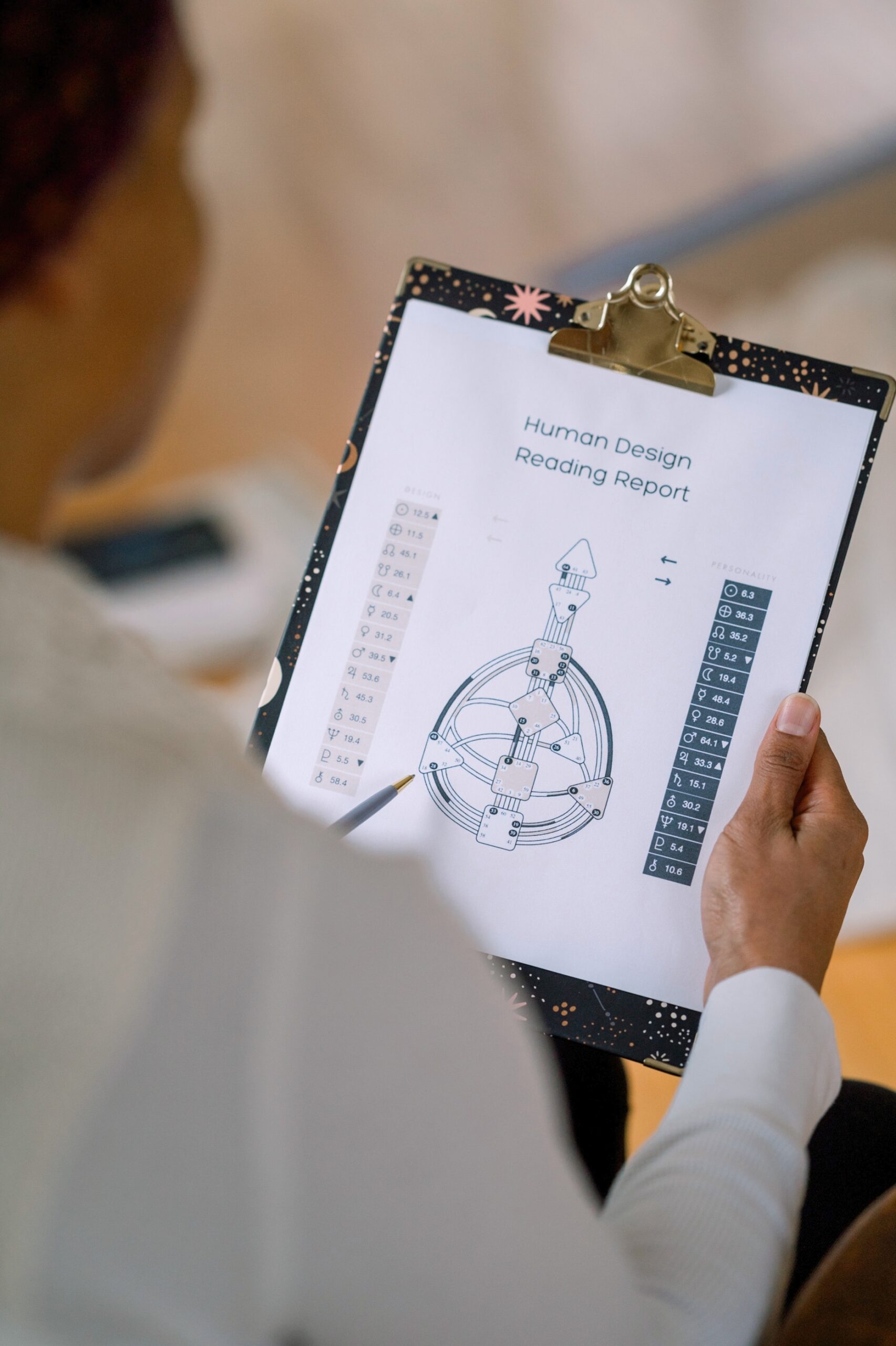
Most high-achievers are not short on tools.
You know how to plan, prioritize, and execute. You can push through a long week, figure things out as you go, and carry responsibility without much visible friction. From the outside, things usually look fine.
What brings people to Human Design is not confusion about how to work harder. It is the growing sense that the way they are operating requires constant self-correction.
The burnout. The decision fatigue. The feeling that your life only works because you are actively managing it at all times.
That is rarely a motivation problem. It is more often a mismatch between how your energy actually functions and the systems you are trying to live inside.
Human Design gives language for that mismatch.
What Human Design is actually pointing to
Human Design looks at how you are built to use energy, how you are wired to make decisions, and what kind of pace your system can realistically sustain over time.
It uses birth data, but the value is not prediction or personality labeling. The value is pattern recognition.
Instead of treating exhaustion or inconsistency as personal failure, it gives a framework for noticing where effort is being wasted and where pressure is being absorbed unnecessarily.
I use it as diagnostic information. Not as identity. Not as destiny.
Start with energy type, not the whole chart
When people first look at their chart, the most useful place to start is energy type.
Energy type describes how your system interacts with work, rest, and momentum. It also explains the most common ways people burn out when their lives are structured without regard for that energy.
Manifestor
Manifestors are designed to initiate. Starting things tends to come easily.
Problems show up when their days are over-structured or closely monitored. Too many approvals, check-ins, or expectations to be constantly available can drain energy quickly. Manifestors tend to function best when there is room to move independently.
Generator
Generators have sustainable energy when they are engaged with what they are doing.
The trouble starts when obligation overrides interest. Saying yes because something is expected, rather than because it feels correct, slowly depletes energy. This often shows up as resentment or fatigue that seems out of proportion to the workload.
Manifesting Generator
Manifesting Generators move quickly and often work best in bursts.
They tend to struggle when they force themselves to stay with things that no longer hold their attention. Variety is not a lack of focus here. It is part of how the system stays regulated.
Projector
Projectors are not built for constant output. They are built for guidance, pattern recognition, and efficient use of energy.
Burnout usually comes from trying to match the pace of people who have more consistent access to energy. Many Projectors push past early signs of fatigue because the work still looks manageable, until it suddenly is not.
Reflector
Reflectors are highly sensitive to their environment.
When something feels off, it is often less about internal motivation and more about surroundings, relationships, or context. Their energy is affected by where and with whom they spend time more than most advice accounts for.
The common mistake with misalignment
High-achieving people tend to treat misalignment like something to fix.
New systems. Tighter routines. More discipline layered on top of an already full structure.
That approach usually increases strain.
Misalignment is feedback. It is information about what your current setup requires you to override. When that information is ignored, the body eventually steps in.
Some patterns show up again and again:
- Manifestors exhausted by too much oversight
- Generators drained by constant obligation
- Manifesting Generators forcing themselves to stay interested
- Projectors overextending because things still appear manageable
- Reflectors struggling in environments that never settle
None of these are character issues. They are signals that the system no longer fits the person operating inside it.
Decision-making without constant mental load
A large portion of burnout is tied to decision fatigue.
Human Design includes something called authority, which describes how your system is built to arrive at clarity. In practice, this often removes pressure to decide quickly or logically when that approach is not actually reliable for you.
In simple terms:
- Emotional authority tends to need time before clarity settles
- Sacral authority responds clearly in the moment or it does not
- Splenic authority registers instinctively and briefly
- Ego authority relies on desire and willingness
- Self-projected authority becomes clear through speaking
- Lunar authority needs longer cycles before committing
This is not about ignoring logic. It is about choosing at the right moment, with the right information, instead of forcing decisions under pressure.
When people adjust how they decide, anxiety often drops because fewer choices are being made prematurely.
What tends to change when systems start to fit
When people stop working against their energy, a few things usually happen.
They spend less time second-guessing decisions. They notice fatigue earlier instead of after the fact. They stop relying on willpower to hold everything together.
This does not require a full life overhaul.
Small shifts matter. Paying attention to what consistently drains you. Noticing where you push through instead of responding. Trying one decision using the method your system actually supports.
Human Design is not here to tell you who to become. It is a way of understanding how you already work, so your systems can be built to support that instead of compensating for it.
Take what’s useful. Leave the rest.



Be the first to comment